
Construction Cost Calculator
Estimate total construction cost by project type, square footage, material quality, and labor rate: instant breakdown of materials, labor, and contingency.
Built by Toolsque Team · last updated September 17, 2026 · checked against our testing process
Related: construction cost planner workflow · job costing calculator · all construction calculators
How to use this construction cost estimator
- Select your project type: new construction, renovation, home addition, or light commercial. This sets the default material and labor cost presets for that category.
- Enter the total area in square feet: for a room remodel, measure the floor area; for a full build, use the total conditioned floor space.
- Choose material quality: Budget uses builder-grade materials, Standard covers most residential mid-market work, Mid-Range is for upgraded finishes, Premium covers high-end custom work. Override the preset with your own dollar-per-sq-ft figure if you have actual quotes.
- Enter labor cost per square foot: leave blank to use the category default, or enter the figure from your contractor quote.
- Set your contingency buffer - 10% is typical for defined scopes, 15-20% for new builds or uncertain projects.
- Read the breakdown: material cost, labor cost, contingency, and total update instantly. Use the total as your budget target before getting contractor bids.
How much does construction cost per square foot?
This construction cost calculator works out a total from your square footage, build type and finish level. Construction costs in the US typically range from $100 to $400+ per square foot for the total project (materials + labor + contingency), depending on project type, location, and finish level. New builds average $150-$250/sq ft nationally for standard construction; major renovations run $75-$175/sq ft; light commercial projects often fall between $100-$220/sq ft. These numbers shift significantly by region: labor in California or New York runs 40-60% above the national average.
What drives construction cost estimates
Material cost is the largest variable. Budget materials (basic lumber, standard fixtures, builder-grade finishes) cost $40-$90/sq ft. Standard mid-range materials run $75-$130/sq ft. Premium or custom finishes: stone countertops, hardwood flooring, custom cabinetry: push material costs to $150-$270/sq ft or higher. The calculator above uses these ranges as presets; enter your own figure if you have contractor quotes.
Labor accounts for 30-50% of most project budgets. Trade labor rates vary: general contractors charge $50-$100/hr, electricians $65-$130/hr, plumbers $70-$140/hr. Per square foot, residential renovation labor typically runs $25-$75/sq ft; new construction averages $50-$85/sq ft.
Why you need a contingency buffer
No construction project comes in exactly on estimate. Hidden structural issues, material price swings, permit delays, and scope creep are standard, not surprises. Budget 10% contingency for well-defined renovation scopes, 15% for new builds, and 20%+ for older structures or projects with unknowns. Underbidding your contingency is the most common cause of construction project overruns.
Using this estimate with other tools
Once you have your estimated project cost, pair it with our contractor markup calculator to check whether a bid includes reasonable overhead and profit, or run it through our job costing calculator to track actuals against estimate. If you are evaluating whether a project makes financial sense before committing, the break-even point calculator helps model the revenue needed to cover build costs. When the job is done and invoices are due, generate professional invoices with our free invoice generator: no signup required.
How this estimate is calculated
Material cost = area (sq ft) × material rate per sq ftLabour cost = area (sq ft) × labour rate per sq ftContingency = (material + labour) × contingency %Total = material + labour + contingencyWhat this estimator does not cover
This tool outputs a hard-cost baseline only. It excludes soft costs, which typically run 15 to 30% of hard costs on commercial projects: architect fees (6 to 12% of construction value), engineering, permit fees, soil testing, and title insurance. Land acquisition, financing costs, and developer fees are also outside scope. For residential projects under IRC Section R301, the authority having jurisdiction (AHJ) sets its own fee schedule: common range is $0.10 to $0.50 per $1,000 of valuation. Factor these separately before presenting a total project budget.
Material grade and labor tier errors
A common mistake: applying national average labor rates to union-heavy metro markets. In cities with Davis-Bacon Act coverage on federally assisted projects, prevailing wages run 30 to 60% above open-shop rates. Similarly, specifying ASTM A615 Grade 60 rebar versus Grade 40 changes material cost by roughly $0.08 to $0.12 per pound. Lumber species matters: Douglas Fir framing costs approximately $0.95/linear foot versus Southern Yellow Pine at $0.75/linear foot for equivalent structural grades. Always confirm material grades against IRC Table R602.3(1) before locking any estimate.
Reconciling the estimate against contractor bids
When live bids arrive, reconcile line by line. A bid exceeding your estimate by more than 20% usually signals scope creep or a different material spec: not market error. Use the contractor markup calculator to reverse-engineer a bid's embedded overhead and profit, and the job costing calculator to track actuals against estimate through the build.
Three worked examples using the tool's default rates
Run these through the calculator yourself to check that your own numbers land in the same range.
- 2,000 sq ft standard new build: materials at $120/sq ft = $240,000, labor at $60/sq ft = $120,000, plus 15% contingency of $54,000. Total $414,000, or $207/sq ft.
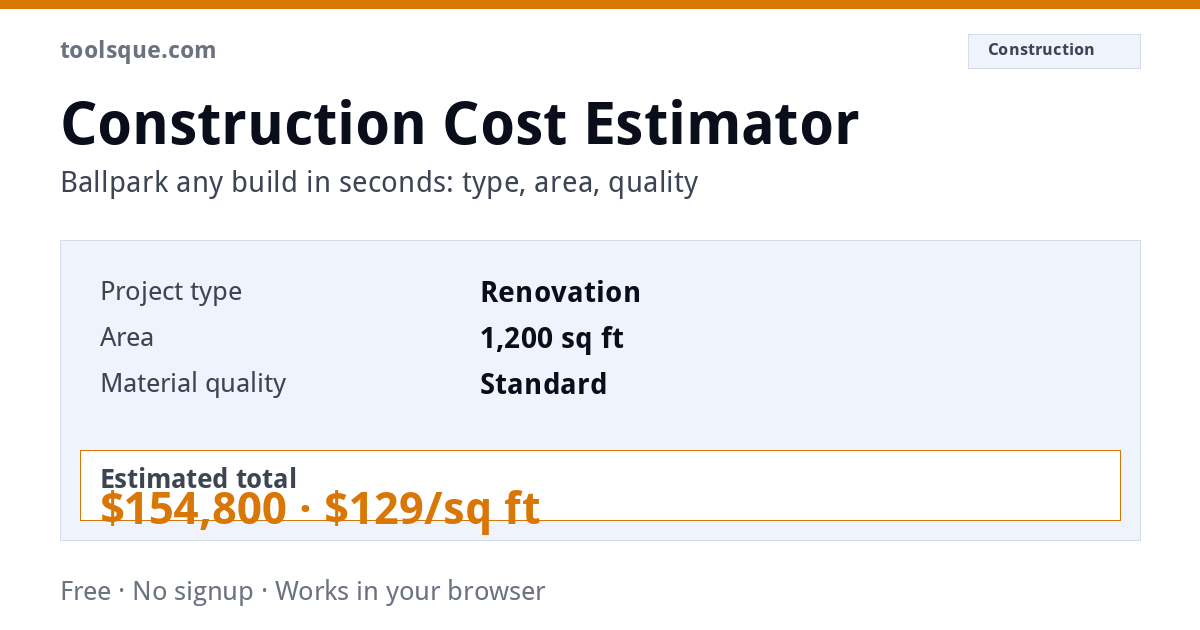
- 1,200 sq ft mid range renovation: materials $144,000, labor at $40/sq ft = $48,000, plus 10% contingency of $19,200. Total $211,200, or $176/sq ft.
- 400 sq ft mid range addition: $74,000 materials, $28,000 labor, plus 15% contingency of $15,300. Total $117,300, or $293/sq ft. Additions cost more per foot than new builds because kitchen and bath work is denser per square foot, and tying new framing and systems into an existing structure adds labor that a from scratch build does not carry.
Regional cost index
Apply a multiplier to the national total based on where you build. National average equals 1.00. San Francisco Bay Area typically runs 1.4 to 1.6. NYC metro typically runs 1.35 to 1.5. Seattle and Boston typically run 1.2 to 1.35. Texas metros typically run 0.90 to 0.95. Rural Midwest and South typically run 0.80 to 0.85. Applied to the $414,000 example build, that reads roughly $580,000 to $660,000 in coastal California and roughly $330,000 to $350,000 in rural Midwest.
Checking the permit fee figure
A permit fee of $0.10 to $0.50 per $1,000 of valuation works out to about 0.01% to 0.05% of the project cost, far below what most building departments actually charge. Most US jurisdictions charge 0.5% to 2% of project valuation for a building permit. On the $414,000 example that is roughly $2,100 to $8,300, and plan review or impact fees can add more on top in high growth counties. Always confirm the exact fee schedule with your local building department before you budget it, since rates vary by city and county.
Trade by trade share of hard cost
| Trade | Typical share | Dollars on $360,000 hard cost |
|---|---|---|
| Sitework and foundation | 10-15% | $36,000 to $54,000 |
| Framing and shell | 15-20% | $54,000 to $72,000 |
| MEP (mechanical, electrical, plumbing) | 20-25% | $72,000 to $90,000 |
| Interior finishes | 25-30% | $90,000 to $108,000 |
| Roofing and exterior | 8-12% | $29,000 to $43,000 |
Use this table to check a contractor bid trade by trade instead of just as one lump sum. See the job costing calculator or labor cost calculator to break your own project numbers down further. If you are pricing the job for a client rather than building for yourself, add your markup with the contractor markup calculator, since this estimator only covers direct material and labor cost, not overhead and profit.
Frequently Asked Questions
How accurate is a cost-per-square-foot estimate?
Square footage estimates are good for early budgeting: expect plus or minus 20-30% accuracy until you have contractor quotes. Material and labor presets are US national averages; local labor rates and material availability shift numbers significantly. Use this tool to set a budget range, then get 3 contractor quotes to narrow it.
What is not included in this estimate?
Land cost, permits, architectural or engineering fees, interior furnishings, landscaping, and utility hookup fees are not included. Add 15-25% to your total for these soft costs on a full new build project.
What contingency percentage should I use?
10% for tight, well-defined renovation scopes with no structural unknowns. 15% for new construction. 20% or higher for older buildings, historic structures, or projects with significant scope uncertainty. The contingency is not profit: it stays in reserve against overruns.
How do I find the labor cost per square foot for my project?
Ask each contractor for a breakdown of their labor charge per square foot in their quote. Alternatively, take their total labor line item and divide by your project area. The US national average for residential renovation labor is roughly $35-$55/sq ft.
Is this calculator useful for commercial construction?
Yes: select Light Commercial as the project type. The presets adjust to typical commercial build-out costs. For heavy commercial or industrial projects, material and labor costs can be 2-3x higher; consult a commercial estimator for those scopes.